Sunday, 27 November 2011

Stoke Newington Baptist Church, Stoke Newington High Street, 20.11.11

The economic apocalypse is nigh. Don’t fear war, pestilence, famine and death but instead run to your Bible and pray to stop the rise of cuts, inflation, unemployment and debt. Not that all cuts are bad cuts, some cuts can free communities from needless bureaucracy. Inflation is also fine as long as it remains low and stable in conjunction with the rate of employment. Unemployment would not be the end of the world if you have a good welfare state providing financial and social support. Even debts can be solved by low interest bank loans. No, the economic crisis is not comparable to The Book of Revelation as the international news media would like you to believe but this Sunday even God became victim to the global recession.
 God and money have an odd relationship, all men are created equal in the eyes of God but money is often how we attempt to measure a person’s worth outside the dogma of religion. Money is a value system formed long before science knocked religion off its creationist perch and is the longest provocateur to religion. Christianity sees money as an essential tool in spreading the Lords Word but Bible is not so kind towards money. Money appears in the Bible as the tool of the oppressor and the religious prophets are far poorer and humbler in their existence. For example: Jesus is not a rich man- it's essential that he gave everything to the poor and the needy. The majority of non-believers criticism of the church is that they take money from the poor and sell them hope through the promise of heaven.  Non-believers feel uncomfortable at the site of wealthy churches and often think would Jesus approve of such extravagance. So when I arrived at the modest stone face of the  Stoke Newington Baptist Church and entered the fairly rundown interior of the nave my heart lifted that this was a church rich in ways not so obvious to the eye.
The church was filled with understatement; a modest altar, a very low tech projector and a small stained glass window marked the sanctuary out from the collection of black chairs that filled the nave. A few religious decorations hung across the nave’s walls, leaving the colours of beige, brown and cream to blur into one nondescript glow that was strangely affecting. This corporate like conference room had been spiritually converted and despite the placidity of its design it had risen to a higher purpose. The lack of grandeur and glamour did not indicate a lack of care from the congregation but mere signs that life took precedence over material spectacle. The environment should not have been inspiring but the large mixed congregation led by Pastor John Taylor generated a community atmosphere not found in the architecture of government buildings. The service’s ramshackle beauty was typified by the church band, an odd collection of saxophonist, keyboardist, Organist and Violinist; who naturally struggled with some hymns until the late entrance of the resident drummer; a young black kid no older than 14 with low hung jeans, baseball cap and Nike raincoat and who acknowledge nobody as he waltzed up to the kit before he began to pound the drums mid hymn. The music should not have worked, technically it did not work but you could not fault the harmonious joy the audience and band shared. The humble and modest yet still joyful and triumphant congregation of Stoke Newington Baptist Church had spirit for these economically tough times but I was yet to learn the precarious practicalities of their situation.
Pastor John Taylor carried a statesman like air of importance when he spoke with a realist’s modesty. His untypical sermon was not concerned with the spiritual transformative love of Jesus Christ but the practicalities of the church’s annual budget and outlining the amount that would be apportioned for Christmas giving.   Perhaps the sermon lacked the romanticism of the Holy Scripture for the majority of the congregation but I personally found his speech enthralling as I discovered how the church spends its money. The most heart-warming aspect of the church budget was learning that alongside the money given to the Baptist Union, Christian Fellowship schemes and International aid was the name of one family household who needed help after falling victim to hard times (to one of the economic four horseman no doubt).  Charity within a community is something so rare to in fragmented London it filled me with early Christmas cheer. However after Pastor John Taylor asked the congregation to discuss with him during the break any issues some may have, he returned from the break stating no one had talked to him. I guess the community trusted their pastor as they were far more familiar about the church’s spending and would prefer to sing, dance and praise the Lord than worry about how the collection plate is spent. It’s rare that a Church would be so transparent with its budgets yet Pastor Taylor was keen to indicate that the annual micro budget was necessary to contextualise the larger economic problems facing the Baptist Union.
Just like businesses, nations and continents, churches are economically failing. This year the Baptist union ran approximately one million pounds over budget, it can sustain the same deficit next year but if the Baptist Union funds don’t improve in 2013 it realistically will see churches close down and subsequently merge.  A symbol of the economic decline is the Baptist Times (running since 1855) which will be discontinued this year as it loses the church money. Like secular forms of the print industry whose economic interest has declined due to the digitalisation of the media, the Baptist Times is not a viable source to spread the word of God. The prospective changes facing the Stoke Newington Baptist Union did not seem to worry the congregation. A large portion of the congregation were from Africa and particularly Angola, and some elder members had the sermon translated into Portuguese. The congregation were very helpful in explaining that the church had once been predominantly white but in recent years Pastor John Taylor had shared the pulpit with an Angolan minister. As time passed the Angolan minister returned to Africa but the influx of an African congregation survived and integrated. Services went from being held in English and Portuguese to just English. Arguably the unison between the elderly white church members and the new African arrivals is not simply a spiritual meeting but one that is economically formed through globalisation of the 1990s. The church in many respects has already proved its ability to adapt to a changing economic environment so why should they not believe the congregation can overcome such future struggles.
The central reason for the congregation’s resolve is that they have faith in a higher power and The Rapture is a far scarier prospect than the current global economic downturn. Secular society could easily dismiss such faith in higher powers as blissfully ignorant but maybe we should look at ourselves and our own ignorant faith we have put into the financial market. In the most simple and reductive explanation to our current economic crisis  I would state that the crisis in the US, UK and rest of Europe is born out of the ability to trade off debt through credit that is supplied by banks under the guise that the company/country/continent will make a future profit. Clearly the global economic system is not that simple but neither is The Bible which is far more publically renounced than our global financial market.
 The market and the Bible claim to be based on truth, their power comes from a faith based language in which words only have importance if you believe in them. Borrowing and lending is a part of human nature which has offered a practical solution throughout history in building trust within communities (like loving your neighbour or treating others how you wish to be treated) but when you enter the world of derivatives, futures and hedge funds you are creating a language and belief system to legitimise an impractical monopoly. I don’t believe that derivatives, futures and hedge funds are a real solution to our economy but are a fiction that has been given political currency and have been used to enslave the many by the few. Take the last sentence and replace the words, derivatives, futures and hedge funds with the words God, The Holy Ghost and Jesus Christ and you would replicate the a typical criticism the church receives within an atheist media. However God is not making me redundant, The Holy Ghost is not reclaiming my house and Jesus Christ comes for free. To be religious you have a choice but we have no such choice in belonging to our current Capitalist society, we are told this is truth and we must accept. Not even God can escape the four horseman of cuts, inflation, unemployment and debt but at least his followers can sing and dance waiting for a better life. Congregation's belief can make even a small church made from a pile of stones as rich as the kingdom heaven.


Not wanting to patronise the reader but please see below for my biased definitions of derivatives, futures and hedge funds:
A derivative is a contract for payment between two parties that is a dated transaction and has no independent value but whose price is derived from an underlying asset (commodity, stock or share). Controversially a derivative has legal exemptions (in the US) and is an attractive proposition in extending credit despite the value of derivatives fluctuating based on the market.
A Future is a future contract for payment between two parties for a specific asset of standardized quantity and quality for a set price, with delivery of the asset occurring on a future date. In the future the asset may have lost or gained profit so it will always be gamble for the buyer and the seller and never a fair trade.
A hedge fund is a private pool of capital managed by an investment advisor. A hedge fund is only open to investment from accredited or qualified investors. Hedge funds look for trends in the global financial market to trade and their activities vary but they would not be as powerful if derivatives and futures did not exist. Arguably derivatives and futures can be used to counter balance the risk of trading, hence the term “Hedging,” in which the fund has the opportunity to make money from money. 
Personally all of these financial tools have no grounding in reality and merely make money from money or makes money from the belief people have in money, like gambling without the sport. 

Saturday, 19 November 2011

St John on Bethnal Green, Cambridge Heath Road, 13.11.11

A minute’s silence outside the Bethnal Green library took the length of an entire sermon. To be fair to that elongated minute it took several minutes beforehand for the parade of clergy, Territorial Army, Royal Marines and Navy, Her Majesty’s Air Force, the Metropolitan Police, St John’s Ambulance, several cadets, beavers, cubs and scouts, plus one peroxide blonde widow dressed in all black, several tearful families and the rest of the congregation to walk respectability down Cambridge Heath Road. Respectability does not rush and nor do most people on a Sunday when confronted with a memorial parade. My sympathies were with the regular congregation who with a sermonless service had to seek solace in the silence. The annual invaders had taken over the running of the church like their compatriots throughout the country, an institutionalised occupation not to be confused with the current protests that surround St Pauls. The price of the Anglican Church’s wealth is that once a year Jesus, The Holy Spirit and God himself are held hostage by the dead who had defended their names (despite most likely not believing in them). A week not for moral, theological, or metaphysical questions but instead an exercise in obedience masquerading as an act of remembrance.
A remembrance of people we had largely never met. The worship was such pure ritual and routine it could easily be mistaken for a military operation. A vast array of distinguished uniforms filled the nave which made the priest’s attire seem normal but the collection of camouflage was not an adequate distraction to my own questions. Ironically the one minute silence seemed to speak to me more than the familiar fifteen minute sermon. Within the spiritual void or the moral vacuum that was the silence I came up with my own pacifist plea for the pulpit. Following in the footsteps of my God serving Granddad who always resented remembrance Sunday here is my sermon on the silence I respectfully observed but cannot agree with.
A minute for who? And why not an hour? Who decided a minute for mourning was an adequate time to shed your tears? If we are remembering people we have never met why should I only remember those who have fought for the British forces? Is remembering something that you have never experienced a charitable lie?
But my questions feel like half formed sentences leading to their own answers. 
The minute is for the men and women of the British Armed Forces who died serving their country as well as the families and friends who have lost those close to them. It has to be a minute as an hour might allow the death toll to rise as more veterans, soldiers, cadets, scout, cubs and beavers could die. A minute is deliberately too short to shed any tears, so the minute becomes an annual symbolic medal that reaffirms British reserve when faced with such ritualistic tragedy.  It’s expected that we only remember our own but I cannot forget the pictures of the non-partisan burnt, dissembled, and dead bodies of Libya, Iraq, and Afghanistan.  My problem is that as a charitable lie our Remembrance Sunday is limited by locality and not generous enough to pay tribute to the dead enemies who are born from outside our shores. 
Clearly I am a lost liberal caught in a cloud of jingoistic nationalism that has grown to a more epidemic fever in recent years. Conduits to this rise of military nostalgia is the Sun newspaper’s Help for Heroes campaign, the influx of reality TV and documentaries on our Armed Forces and the PR  mourn machine that was Wootton Basset.  A new season is upon us and this year the poppy has grown beyond its natural environment into the world of marketing. Forget the token paper flower or even the metal badge, we are pollinating the internet with our poppy idents, branching out into poppy car bumpers and branding any public services with poppy insignias.   Grief is ubiquitous in our consumption and it threatens our sense of reality by becoming a token of the everyday. The silence and the signs assume our support for human sacrifice but such tragedy does not need to be tolerated. The entire media campaign finds the pacifist within me can only feel numb with anger. Anger reserved for the accusers who claim that I am being deliberately difficult, disrespectful and different in my choice not to wear a poppy on my jacket.  Who see my belief as apocryphal, arrogant, and antagonistic and are not willing to believe that it’s a thoughtful, considered and genuine response. Peace is only a pose in these people’s eyes and hypocrisy is natural. Who would want to see the popular poppy as a direct support to the unpopular wars in which our troops die? The Royal British Legion does great charitable work in helping the lives of troops and their families but it is still guilt money to the larger evil of war itself. If I am going to wear a symbol to commemorate those who have died in unnecessary violent conflicts then my symbol should unite all divisions because only in death are we all equal. 
I am all for freedom and ridding the world of tyranny but before we choose to save others we must emancipate ourselves from nationalism and we can start with the poppy. The Poppy has become a prisoner of war it does not belong to us or those who died on the battle fields of Bazra, Belfast or even Flanders. Long before mechanized warfare between nation states the poppy was a symbol of sleep, death and remembrance bound to no particular country, continent or history. Now the poppy seems to have been appropriated by the British and to a lesser extent its old colonies of Canada, Australia and New Zealand.  Alternatively we have the Peace Poppy, the white paper poppy that I spent two hours searching central London for to no avail.  The peace poppy is the pacifist’s attempt to fit into Remembrance Sunday it’s the sort of politically correct trite that appears clumsy but is well meaning and far more Christian in spirit. Why are Peace Poppies unpopular? Because peace is unpopular, unpopular because it does not make money and sadly wars do. Wars make a lot of money and and they also make lot of pretty paper red poppies. For some, war is to be supported but for others it is merely to be observed and there is no better way to observe the cost of war but in a silence that is shared with those not willing to be quiet.
Searching in the silence for some meaning I looked outside my obedient group, past the berets, caps and helmets I spotted a young quiet Muslim girl dressed in black from head to toe with only her enquiring face exposed. She was respectful and interested as her eyes inspected the parade on display. Observing a military Christian rite you would expect her to feel isolated but in the silence her presence became an acceptance or blank canvas for me to draw on. It would be wrong to presume all the thoughts that remain unsaid and to place my anger within her mouth. Anger at wars I had not fought in, anger at people I had not met and anger at myself for not succumbing to a sense of national pride: an anger that was only relieved by the remembrance of the dead being disturbed by the sound of the living. A silence unravelled by the sound of Sunday shopping, broken by the sound of congested traffic and then decimated by the earth shattering sound of sirens. Even in that minute of silence an ambulance sped down Cambridge Heath Road, followed by two police cars and one motorbike and it finally dawned on me that tragedy takes no time so we best make the most of the minutes that we have. 

Sunday, 13 November 2011

Christ Church, Spitalfields, Commercial Street, 06.11.11.


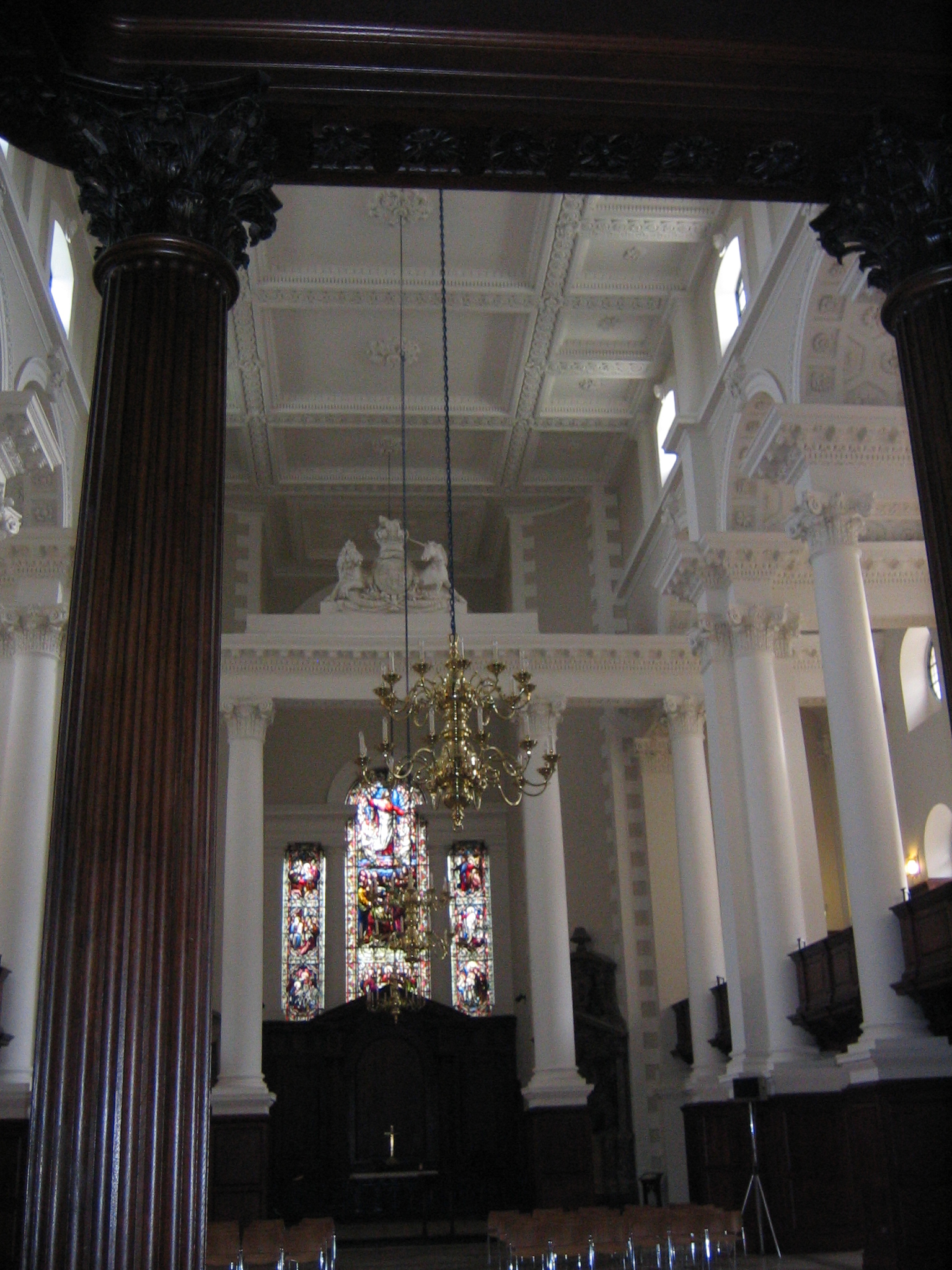
File:Ch ch spitalfields.400px.jpgThis Sunday is my birthday or last Sunday was my birthday (if we go by the post date) and I gave myself a little present by going to my favourite church in the East End, Christ Church Spitalfields. An unoriginal choice, the church has rightly been heralded as one of the most beautiful religious buildings in Europe. The building is a symbol of the changing face of London’s East End. The church was originally built from 1714 to 1729 based on the designs of Nicholas Hawksmoor. Hawksmoor was under the government incentive to assert an Anglican dominance over the migrant sections just outside the city (particularly French Protestant Hugenots). However the church’s restoration from 1976 to 2004 mirrors the gentrification of the area from East End slums predominantly inhabited by low income migrants to commercial buildings that currently house one of the most powerful financial sectors in the world. Anglican dominance seems to have survived in the form of commercial gentrification, not that the Anglican church appear to be very pleased with the banking world if the current St Pauls Occupation is anything to go by. A church with such history is hard to comprehend and that is not even considering its stunning architecture or the actual church service.
The congregation seem very proud of the building’s history but they don’t let that distract them from God. Self-consciously the church rector Andy Rider and curate Johnny Douglas mentioned the church’s fame as a tourist site and the need to remind outsiders that the building was still a practicing church. One of the gentleman mentioned this directly after I had informed a lady from  the congregation of my agnostic pilgrimage, and that is was my birthday and how I had decided to reward myself by visiting the most architecturally beautiful church in London. As soon as my materialism had been mentioned within the service my weekly dose of guilt ran riot through my head. What was the true way to experience Christ Church? Not finding answers within the service like most believers, I took to the atheist’s bible, the Google search engine. My online discovery was that Christ Church has its very own Holy Trinity of websites, three very professional sites that explore three very different aspects of the building. They are listed below in order of importance (according to Google)
1.       The Father: The Friends of Christ Church, A website dedicated to the restoration of Christ Church of Spitalfields. http://www.christchurchspitalfields.org/v2/home/home.shtml
2.       The Son: Christ Church Spitalfields Venue, A website that markets all the venue potential for renting the church for private events. http://www.spitalfieldsvenue.org/node/1/
3.       The Holy Spirit: The actual Anglican Church website dedicated to promoting the Word of God (Google clearly has no religious bias). http://www.ccspitalfields.org/
All of these websites are very impressive and are highly informative within their own fields. So impressive that it made my weekly blog entry even more irrelevant. It would be wrong to compare them and grade them but I was hard pushed to find a better way of illustrating the many dimensions to this geometrically astounding church. 
In the beginning there was The Father (God) but in the history of Spitalfields the oldest building of Christian worship still practicing is Christ Church. The restoration that has returned the Church to its original form was led by “The Friends of Christ Church.” The group are affiliated with the church but are also separate body and did campaign with the Hawksmoor Committee in the 1970s to stop a wholesale demolition of the empty building—proposed by the then Bishop of Stepney, Trevor Huddleston. True to form the Anglican Church later saw the opportunity “The Friends of Christ Church” presented and they began to work together. “The Friends of Christ Church” of Spitalfields started in 1976 and has raised and spent £10 million on an award winning restoration. The restoration was a long and patient process that was hugely praised for its attention to detail in recapturing Hawksmoor’s original design. The whole building restoration spanned from 1976 to 2004 and “The Friends of Christ Church” continue to raise money with the hope of restoring the 1735 organ. The website is great in exploring the history of the building and providing a context to the wonders that surround me. Anyone who has visited the church and was inspired by its beauty should visit the site but it does not speak for the building today and its modern use as a Church but also as a venue.

File:Christ Church 037.jpg
The Holy Spirit comes from the people within the church and it’s the job of the believer to keep it alive, so it would be a disservice (excuse the pun) to review the Church’s website in drawing conclusions about the congregation. People may provide the spirit of the Lord but a certain place will attract a certain congregation. The congregation appeared to be from richer, more educated and from more middle class stock than churches that are housed further from the city. It was not money that made an impression on me (despite sitting in a £10 million restored Hawksmoor nave) but creativity. The modern Christian hymns had an evangelical vibe, live bands putting Bible stories to the melodies of Snow Patrol, Cold Play or some other mediocre, inoffensive rock band. The atmosphere was impressive in comparison to the more rigid sung Eucharist practiced at more high Anglican churches across the East End and Communion was replaced by a community lunch. The congregation felt like a modern Christian community and was led by the rector Andy Rider, who carried the air of a man auditioning for Songs of Praise as he welcomed people to “join him in exploring the character of Jesus and partaking on a journey to see God in the everyday.” Andy’s casual but considerate English demeanour was countered by a passionate, in your face, Irish curate, Johnny Douglas. Johnny had the demeanour of a stand up, so articulate he verged on the poetic, his sermon creatively digressed until it felt like one man’s theological monologue written for the stage. Impassioned personalities are highly seductive and ultimately disappointing when you realise that for all Douglas’s dramatic and complex word play he was simply praising his love for Jesus. I was impressed by the service but like the websites it fell short of describing my love for Christ Church.
My love for Christ Church is ethereal, over the last year if I have learned anything from going to church is that love for a Christian is a belief that is only explained as a feeling despite the Bible’s attempts to articulate its meaning. So a part of me knows I will spectacularly fail to explain my love for Christ Church in this remaining paragraph and it will remain an elusive and private pleasure. To experience any building one should visit but hearing other perspectives can still enrich ones impression. So here is my web testimony, I would not call it a poem, musings sounds too high brow, I think pretentious drivel is more an accurate description but what do you expect when a man with an insufficient vocabulary is faced with a building of such magnificence.
GODS HOUSE
The door drags you into its depths
While the spire stretches for the sky
It appears to looms over you yet leans away
Heaven should not be this hypnotic
Such seduction feels almost satanic
A Contorted Christian
The building simultaneously rises as it falls
The higher my head goes up the lower it sinks
Eyes caught between cocoons of time
God’s country knows no borders
As a Greek pediment perches on a collection of Tuscan Columns
This bricolage bastard is from Venice, Paris and Athens
An architectural migrant from the many motherlands
It marks where old countries end
And new ones are born
Born from the bones of the old
They have call it “British Baroque,”
Sounds so stupid it must make sense
Not a sense that can be explained in a sentence
Or the sense that helps you see, hear, smell, taste or touch
But the sense that helps form the sensual
The sense taken from sensational
A sense caught between senseless nonsense
Like Christ in a Church.


Sunday, 6 November 2011

Shiloh Pentecostal Church, Ashwin Street, Dalston, 30.10.11

Ok here is something a bit different. I have been getting a bit bored of the sound of my own writing (but I still love an oxymoron). So I have decided to write a piece of fiction inspired by my visit to Shiloh Pentecostal Church on Ashwin Street . None of these names in my post are real people and some information has been altered to avoid upsetting certain people. Most of what is written is a white middle class agnostic boy’s fantasy about an elderly working class West Indian Christian woman. Hope it’s not as portentously offensive as I first feared. Pray for me.
Sister Seymour don’t smile! So say the children. The pearls of her mouth stay hidden when the children use such poor grammar. A steely stern face with a square jaw and beady eyes are set in a forever frown, unforgettable in her expression and inquisitive of others. An aged beauty queen, she wears her maturity proudly but stiffly, her captivating appearance demands attention but her temperament will turn to anger at those who stare. Once pretty but now glamorous, she is an icon mistaken for a relic by those outside the church walls. Casting a stretching shadow from such a small stature, her presence is as far reaching and powerful as her frame is thin and frail. The children don’t know why they are scared but they are, maybe it’s because Sister Seymour asks so many questions without speaking a word.  What reasons can be read from those wrinkles? Who got the goat of the God fearing Gran? And why should the children share her scorn?
So much time has passed Sister Seymour that she is destined to be late. Feet, ankles, calves, knees, thighs are all set to slower clock hands than life itself. Luckily Shiloh Pentecostal Church’s sole purpose is to elevate oneself outside time and bask in God’s loving grace. Shiloh’s pure spiritual worship is not restricted by the routine rituals of other churches. God is never late the congregation are always early and Sister Seymour follows the Lord so devoutly that she perpetuates his poor time keeping. Straddled between the wooden stair bannister and her elderly companion Dorothy for support, Sister Seymour makes her entrance an hour into the choir’s rhythmic heavy hymn harmonies. Leaving the stairs Dorothy takes all her weight only alleviated by handshakes and hugs that shepherd Sister Seymour to her seat. Everyone knows that without Dorothy such an entrance might not have been possible, everyone knows except Sister Seymour.
Dorothy don’t complain, Christians can’t or shouldn’t. Dorothy knows it will be her time soon, to be the weight that all good Christians must carry. Sister Seymour is not grateful because it is Gods will, Dorothy, Kima, Sister Clarence are all part of God’s chosen few. No hindrance it should be an honour. The Lord is repaying her for 70 years of dedication to spreading his good word but also the millions of escorts she facilitated that saw the elderly West Indian Christian female community of east London be transported from their humble houses to his glorious home. Not that Sister Seymour dislikes Dorothy she finds her company comforting, it’s just that Dorothy is twenty years younger in age and thirty in spirit. Dorothy dresses like a good Christian woman, wearing a bright blue patterned headscarf and matching dress that covers her knees and shoulders offset by a regulatory plain beige raincoat. The blue is a bit too strong on the eyes for Sister Seymour who prefers conventional black and white dresses and wears a large brown cloth hat instead of a head scarf. No Dorothy is definitely the image of Pentecostal purity but she has a tendency to hurry and hassle and sometimes fuss and fight with others, always with opinions that need to be heard to be validated. Sister Seymour reasons that this is due to her spiritually searching; that Dorothy is slightly unrested and insecure in her soul; She will come of age, Sister Seymour knows this to be true and like her she will be more spiritually at peace. Eventually Dorothy will abandon her dynamo dancing for a slower and more constant form of spirituality but for now she must enjoy her senior youth. Sister Seymour does not need to search for God she knows he is here in her and she won’t let him leave.
A Christian circus of celebration or “a carnival to life,” as one past pastor once described Sunday worship. It still entertains, fascinates and touches Sister Seymour but now she knows how to appreciate God in his many images and not just through her own connection. God is most gratuitously on show in the feverish dancing that fills the nave, arms waving, bums waggling; such infectious celebration makes the congregation conduits to the Holy Spirit. For a time she thought God needed her groove and her spirit would be lacking if she constrained her celebrations but she has become wiser to his ways. Cathartic cries from the congregation in response to the choir chimes are essential to church but they no longer hold the key to Sister Seymour’s faith. She can sing him in silence and knows he will hear. Not that the sight of such ceremony does not stoke her heart and give hope for God’s future when she is gone. Raised as a good Methodist girl she remembers coming to this country and it taking years for others to let her celebrate God’s loving grace as she had back home. Joining the Shiloh Pentecostal church in 1978 she recalls the long road to acceptance that led to the regular Sunday serenade of God’s good work in a chapel that the congregation could call their own. Moving into a new building filled with discarded wooden pews from other churches the congregation believed they could never have been richer but now they have a full band, large choir, live PA system, overhead projector and further plans to add a lift to tackle the outside stairs, as well as HD plasma screens for hymns, readings and sermons and even plans ea new vestry. The church has learned that God’s loving grace knows no financial limit.  Time has taught Sister Seymour that such material wealth should not cocoon the church and all new found riches bestowed on the Sunday service should be balanced with preaching the good lord’s word in the pouring wet cold outside Dalston Kingsland’s Shopping Centre on a Saturday.
Others have been and gone but their faces live on in the families that still go to Shiloh. The cycle of Christian learning is passed down through generations. Many would not remember the conceiving of Kayla, the sweet and attentive usherette whose father was the scandalous Derek but Sister Seymour knows all. She was pleased to know, that such a sweet natured girl could come from the neglectful nurture of an often absent father. Age had given her a better perspective of God’s work so she had grown silently tolerant to people’s inadequacies especially the well intentioned. Recent young pastors pleased her but no longer seduced her like the preachers from her past. The young faced, fine dressed and some called handsome preacher from Antigua was such a man that might once have had her swooning in the aisles but he is but a boy to her old eyes. Like the others he too was learning. Last week’s sermon was far too long, the reading could have been paraphrased, the jokes at his wife’s expense were not suitable for a Sunday and the young pastor was yet to learn how to climax a religious rant into an uplifting halleluiah. All these points can be improved once given the time but time cannot save “the broken,” and time has not yet begun for “the reborn.” “The broken, and “the reborn,” are Christian infants and the church’s essential charity cause.
Bessie Walcott calls them “the broken,” but Sister Seymour has learned how cruel and unchristian such gossip and name calling can be. True they are on the fringes of the church community but they are God’s children and Sister Seymour in her later years has found more hope from “the broken,” than from the self-declared saved. Positioned at the back of the nave behind the sound desk “the broken,” are not united by one disability but have been victim to the devil’s many afflictions. Some medical, others mental, but none spiritually disadvantaged. Joy cannot be broken it can only fix one’s soul, so when watching the collection of life’s casualties find such pleasure Sister Seymour almost has reasons to smile but she saves that for the yet to be “reborn.”
The children are clustered in the church corner to the right of the sound desk just in front of “the broken.” More often silent than singing, any non-Christian sound would rightly be scolded by a stare from Sister Seymour. As a self-declared grand high matriarch, her role to rule with an iron fist that is never raised makes her a passive dictator. Only through obedience and discipline can children be reborn to a Christian life, like the disadvantaged their struggle is far more honest to Sister Seymour’s eyes. Not that all the children listen, a broken window in the church nave indicates that few delinquents venture into the church except through chucking stones. The ones who are willing to be taught the trials of life through the cold face of Sister Seymour will gain her approval but it will not be recognised till she feels it’s deserved. The longer the wait the better has always been her reasoning; a few times she let her expression succumb to a smile which caused the children to shout with joy at her amazing pearls on display. A smile is free but does not need to be cheap.  Her own wait has been long and she feels better for it, she is ready herself to see the smile of God and she can feel his mouth creasing at the prospect of welcoming her to heaven. Church quickly taught her that the joy of God is a loud and wondrous thing but only through life has she gradually learned that it is also contemplative and silent. Some spiritualism is so hard to describe it can only exist though an absence, like a face without a smile.

Sunday, 30 October 2011

St Annes, Underwood Road, Tower Hamlets, 23.10.11

We are all starving African children in need of spiritual nourishment according to the Reverend of St Anne’s Roman Catholic Church. Inspired by the latest Oxfam poster campaign with its images of impoverished children our Reverend drew an unintentionally offensive and grossly insensitive comparison to the real famines within the developing world and the plague of atheism in our own. I like a creative metaphor or an exaggerated analogy but the Reverend’s use of Oxfam’s startling images of poverty to sell his God instead of raising funds was beyond opportunistic and verging on the exploitative. Should I expect better from the Catholic Church? They did manage to colonise half the world in the name of charity. I think my shock came when it was declared that this Sunday was Mission Sunday but the service lacked any clear charitable aspirations. The only form of social outreach advocated by the Reverend was that members of the congregation should invite a stranger to church. The Catholic church seemed to think that as long as everyone repents we will not need to raise money to fight the famines, floods and plagues of Armageddon because we will all be safe in heaven. Christianity is so entwined with charity it can be hard to distinguish the churches who really want to help and those who actually need help (i.e more recruits).
Christians want to save people but also many outreach programmes are not interested with ramming God down ones throat instead are wisely more concerned with force feeding the needy with something more essential, like hot food. Fine examples of Christian outreaches in East London that do more practicing than preaching are: The Whitechapel Mission Church established in 1876 as a soup kitchen for destitute lads but has developed into a Methodist outreach programme that provides domestic facilities for the homeless; showers, clothes, counselling, postal address, legal advice, everything but a home.  Similarly Acorn House is a rehab centre run in the grounds of and by the parishioners of St Leonards of Shoreditch. Also St John at Hackney turns the church’s the grand oval nave into a winter night shelter from October to April. I have been less impressed by the Alpha Course or Street Pastor programmes which are not geared to a specific local community or church but alternatively run on a more corporate level with cost charges for their volunteers. The larger corporate outreach programmes seem to focus on the needs of the volunteers over the needs of the client and therefore appear tokenistic not fulfilling a Jesus Christ level of masochism. It’s essential that Christians give back to society but it seems a never-ending debate on what is the most appropriate form of charity. Catholics have obviously decided that the only thing we need to give is the word of God and here lies the accusations of corruption, greed, and hypocrisy.
A Catholic service is an exercise in obedience but also a charitable act. When the congregation pray for forgiveness and receive the Holy Sacrament the congregation are playing a well-rehearsed role of guilty sinner seeking mercy and love from The Almighty. The ritual cannot be changed as it determines the relationship of power. Unlike the more celebratory evangelical services that raise the Holy Spirit, the Eucharist’s set formula creates a clear separation between God and his followers. Catholics hold the most rigid of church services and clearly see the body of Christ as all the food you need to eat on this Earth which would be admirable if the Roman Catholic Church was not the richest in the world. Not that you need to travel to the Vatican to see the hypocrisy of the Catholic Church even in the low, run down areas of London’s East End, you can see wealth peppered around the antique like architectural beauty of St Anne’s of Bethnal Green.  
I counted 38 stone statue angels in varying sizes within the nave, 24 rogue heads overlooking the arched windows, approximately 12 Marys carved from the finest stones, 44 candle sticks, 36 golden and 8 iron, a blinding number of lights, 14 potted plants, a marble gothic altar of saints and angels and a hoard of adornments so luxurious I could not imagine their names. All of these treasures were contained in a 1850s chapel made out of Kentish rag stone with a large rose window over the rustic wooden front door. Every brick and piece of stone inside and out you wanted to smash to see if it was filled with gold. The buildings collection of timeless religious paraphernalia made it feel outside clear modern economic distinctions. Call it age, maturity, history, the church’s opulence felt priceless or is it? A listed building with various antique decorations gave the impression of something greater than grandeur, a place of divine spiritual significance however that’s what the Catholic want you to believe when in reality the church and its many treasures could be used to raise funds for more worthwhile causes.
The Reverend seemed to forget that Jesus did not require followers by preaching that he was the son of God but by performing acts of charity that provided for others and did not benefit him. Arguably the wealth of a church depends on the faith of its followers and despite the grandeur and glamour of Catholicism its money is non-transferable to charity, yet there is no larger or more powerful religious institution in the world. I find it sad that in the poorest areas of the world many will swallow the word of God because they are hungry for food but in the richer society we eat the poor as if they are food in the hope it will bring us closer to God. We eat them as news stories for our papers and TV programmes, as charitable causes for our outreach programmes, and as illustrative victims for our own agenda. We never eat them for who they are but for who we want them to be.

Sunday, 23 October 2011

St Peters of Bethnal Green, St Peters Avenue, 16.10.11,

This week I have not had the time for God or God’s not had the time for me, therefore I decided to attend a short but sweet Anglican service at St Peters of Bethnal Green. The Anglican Church specialises in keeping God alive in the lives of people who would normally not have much time for him. Forever modernising to keep their traditions current, the Anglican Church contains some of the most progressive thinkers but also the most dwindling number of followers.  In contrast to the more recently formed American Pentecostal church who specialise in conservative rhetoric and raising the Holy Spirit, the Anglican Church offer liberal contemplation with a modern makeover. A key facet of being a modern liberal Christian is seeing God in everything you believe to be good. God does not simply exist in the scriptures but also in all of life itself; it takes effort to justify this perspective, an effort I just don’t have the time for. Christians take God from The Bible and relate him to their lives and in doing so they contribute to his creation and development, this is not blasphemous because The Bible and the Anglican Church wants them to do this. 
Reverend Adam Atkinson constantly switched from appearing sincere to smarmy so that you expected he was a politician in a previous life. An Average looking, white, short, male with glasses he was so physically unassuming you were shocked at his lucid and easy going public speaking manner, he was the quintessential priest next door, the good neighbour. Eager to promote a God that can be the be all and end all for his entire congregation, his sermon took the first Bible reading from the book of Isaiah chapter 45.  This verse has liberal emphasise on God existing in all things, being the creator of good and bad instead of separating morality into two distinctions of the devil and God himself.
7 I form the light and create darkness,
   I bring prosperity and create disaster;
   I, the LORD, do all these things.
Book of Isaiah, Chapter 45, Verse 7.

The congregation of St Peters appeared to have found god in all things and achieved Atkinson’s mission to contemporise Christianity. The service begun with a few Christian pop hymns led by a young resident singer song writer, had an interval which consisted of a Facebook montage celebrating a year of Atkinson’s leadership set to a ska soundtrack and concluded with a Bible reading from the stylish all black cover of the New International Version Bible. The covers only text was a black letter acronym “N.I.V” that looked more at home in the Death Metal section of HMV than in the house of God. Disregarding all the fads and fashions that were incorporated into the Sunday worship, the most impressive monument to God was the building itself.

Nestled on St Peter’s Avenue, the church is surrounded by small flats and a school placed in the centre of the square. Its modest flint exterior is powerful for its unusual location and is an understated but confident structure. Unlike Hawksmoor’s baroque churches that demand your attention or the post WW2 churches that look to a new egalitarian Christian building, St Peters was built in the 1800s but defies its origins. St Peter’s would be more fittingly placed on the rural broads of East Anglia than in the centre of multicultural East London. The building has had many renovations but no restoration, like the congregation the building attempts to combine the old traditions with a modern slant. The triangular peak to the spire is so basic but executed so well it does not need the architectural complications of other churches. I cannot see god in the trendy bible covers, Christian pop hymns or Facebook montages but I can appreciate the longevity of God’s people in the unique architecture of St Peters.

Reverend Atkinson was not merely interested in appropriating Facebook, pop songs, and trendy book covers or even celebrating the church’s architectural history, his reading of the Book of Isaiah was asking for the congregation to find God in other areas of their own lives. An important facet of Christianity is it offers individuals the opportunities to personalise God to their own interests thus taking part in his creation and here lies my problem.

  I am currently in the middle of the London Film Festival working as a Box Office manager working for 10 to 13 hours a day, thirteen days straight. Most of my job is dealing with the mass selling of tickets but the few upset individuals who are unhappy with my service will be the people I remember. I do not want to find God in my work, amongst ticket requests, full inboxes, pointless meetings, customer complaints, technical difficulties, disgruntled colleagues, unnecessary stress and general monotony. I like my job but it’s not a religion and I do it for the money not the love of cinema (which I have always had).  I am resigned that I will never find God in church but Atkinson did make me realise that I can find my God in what I do. I can find a spiritual sense of self and integrity by exploring my own interests and through these interest I can feel closer to life, predictably for an agnostic these moments are fleeting and therefore more resonant.

So this is my week’s montage of flickers of godliness: Unfinished sentences that make sense in my head but I cannot read from the page, cycling through the park on a cold crisp sunny October day, singing along to a brass band cover version of Sexual Healing while still in my dressing gown, watching old regulars at work fall asleep on the foyer’s sofas as life continues around them, only awake for cinema but  asleep during real life, the hundreds of epiphanies I have between my head touching the pillow and falling asleep (not that I can remember them), a nice cup of tea, dancing in the shower to Funky Good Time, laughing and not being able recall the joke.

God is created by people and that is why he is powerful but I will not be limited by the belief in one God. The book of Isaiah wants you to think of all the infinite possibilities God has created but ironically one of those possibilities is a world without Bible, the Church and even him. 

Saturday, 15 October 2011

Our Lady Immaculate Catholic Church, Limehouse, Commercial Road, 9.10.11.

Comedians love to take the piss out of the Catholic Church. Catholicism is one of the oldest comedic targets. Only Judaism has sourced more comedy (yet most Jewish jokes are made by Jewish comedians and are often in relation to their race rather than faith). Not that the Catholic Church would give three Hail Marys for the humorous views of a bunch of heretics. The Catholic Church has survived many reformations, sectarian violence and religious wars so a few jokes are not going to hurt them. When you are as old as the Catholic Church it must be hard not to laugh at the criticism and controversy you cause. History has taught the Catholic Church to never take its persecutors seriously and remain defiant of all political attacks. It’s not the rich, beautiful, Baroque buildings of Italy that tempt atheist tourism that have kept the Catholic Church popular it’s the blind faith of its internationally poor and impoverished followers. Doug Stanhope’s joke takes two stereotypes and merely indicates the hypocrisy of history written by the victor that mirrors my own reactionary views towards the Catholic Church. The Catholic Church might not care about their past but atheists and agnostics do, and history not faith has fuelled a divide between the two. Regular readers will have noticed I am more a fan of the jubilant services of the politically right wing Pentecostalists than the routine ritual and religious dogma of a Catholic service. If I am going to worship with groups I politically disagree with I would rather sing and dance than reluctantly join a chorus of whispers disguised as prayers.  Aware I should leave my conservative comfort zone this Sunday I visited Our Lady Immaculate Catholic Church on Commercial Road.
I may not be fan of the Catholic Church but arriving at the service I was shocked at the large, culturally and ethnically diverse congregation. Our Lady Immaculate was a very popular woman and I had to sit in the balcony to get any view of the service. The narrow building had unbelievable depth once inside, that its tall exterior hid from the outsider’s eye. Built in 1934 the church appeared like a giant chimney on the busy main road but inside the sparkling candle lit nave was most heavily adorned by people of all colour.  As we all trawled through the routine prayers and hymns which I could surprising mime correctly without looking at the pamphlet, my eyes were distracted by the congregation. Chinese, Punjabi, Tamil, Italian, Polish, Peruvian, South American, West Indian, Nigerian, Ghanaian, Irish, Philippinoes and cockneys. This was a proper East End congregation, migrants from all over the globe united by Europe’s most popular religious export. The more liberal minded Anglican Church would be envious of such diversity; Stanhope had correctly stated the Catholic Church “is more popular than ever.” The global cross section of the congregation was neatly explained by Reverend’s sermon based on the reading of Jesus’s parable from the Book of Mathew Chapter 22.
In the parable a “certain king” made a supper to celebrate the marriage of his son and invited many to come. Sadly the “certain king” was not that popular so his invitation was rejected by some and his servants beaten by others (the Biblical era was far more brutal than the simple online world of Facebook).  Angered, the “certain king” retaliated on his rude invitees but also instructed his servants to invite everyone across the land to come, calling for the “the good and the bad” to attend. At the wedding banquet the King discovered one man not wearing the traditional wedding garment as was the custom; unconvinced of the man’s excuses he banished the man from the wedding. Jesus ends the parable with the warning that “many are called but few are chosen” (Mathew 22.4) which adds a lot of gravitas to a really shit story. The parable is very a simple story to highlight that God welcomes everyone but one will only be accepted into heaven by following God through the teachings of Jesus Christ. In the Bible Jesus uses the parable to have a dig at the Jews who will later betray him but the Reverend was using the parable in a larger modern context.

The Reverend reminded the congregation that all are welcome but some of us are just “sleep walking” through the service. I am unsure what the Reverend wanted from his congregation, the diverse group all found Christ in different ways and are unified through the church but what does he see as an adequate understanding of Jesus Christ. Catholic services provide a ritual unison but I have yet to experience a sermon which actually specifically questions ones existence towards God (which is so common in the Anglican Church). The sermon seemed to merely prey on the fears of the congregation that they are not Christian enough without indicating what it is to be Christian.  If the Reverend wanted the congregation to awake to spiritual investigation he needs to find better parables. I am not “sleep walking” I would actually describe my experience as attempting not to daydream of God by battling with the rhythmic rituals that bombard you throughout the service. I think the lack of depth of the sermon was typical of the church’s need to appeal to such a wide audience but what the sermon lacked in spiritual depth the ritual enriched.

Rituals can be seductive; it’s so easy to be a slave to the sacrament rather than question the repetition and routine. Conformity is a comfort and the group prayers that I once found scared me I now find a hugely reassuring feature to my week. It is easier to sleep walk in a crowd at a Sunday service than it is during a mid-week lone confession. Looking over the large congregation from the balcony it was touching to see the same text spoken so many ways, some mime the words, others are brave enough to mutter, rare solitary shouters lead the service, mothers are often too busy orchestrating their children and some singletons blindly smile as they speak the text in their head.  Despite the ritual attempt to build unity no ritual can ever be the same and are forever different but they do legitimise the ridiculous. Staring into the sanctuary I was amazed at the grotesque grandeur and glamour. Black and white marble squared floor separated the masses from the holy area. The white and egg shell marble altar had three levels; the top level burned in hope of the heavens with six candle sticks; a congested central level consisted of two candle sticks separated by four potted plants and a heavily adorned holy box; while the lowest level was decorated with shimmering tea lights. The sanctuary shone with wealth like a nouveaux rich house except this brick had been bought by some seriously old money. The grandeur of the sanctuary and the mutters of the mass ritual are instantly recognisable but that does not make it any less ridiculous.

The Catholic Church’s success has been built on conformity. As long as the majority don’t see hypocrisy in the Sistine Chapel and hilarity in the Holy Communion it will remain a social norm and comedic target. I can’t help being the comedian (despite how unfunny I am) it’s an essential default when faced by such mass approval so as to demonstrate your own individualism. My comfort are the jokes that attack such powerful establishments, comedy is essential in highlighting the silliness and corruption of institutions and Doug Stanhope’s brash manner might have attacked the political hypocrisy of the church but you can equally laugh at the ritual. In contrast to Stanhope I have posted a Dave Allen sketch which is 30 years older. The sketch appears very innocent but at the time it was far more mainstream and controversial than Stanhope. What like the sketch it is a comment on religious ritual, except this ritual is simple to understand and therefore far less ridiculous.